

Investment Management
We manage your investments held at Charles Schwab and Apex, and provide advice on your investments held elsewhere. Our investment services include:
Globally Diversified Portfolios
Multiple Asset Classes
Passive and Active Management
Strategic and Tactical Allocations
Expense Minimizations
Tax Optimization
Multi-Manager Approach
Socially Responsible Investing
1 – We are objective
It is essential to make decisions based on objective research that is free from bias. As a fully independent advisory firm, we use any research or solution that is best for our clients. This means we source our research both internally and externally, and partner with several large financial institutions.
2 – We understand your tolerance for risk
Risk tolerance is a balance between your financial ability, financial needs, and emotional willingness to withstand losses. While higher-risk investments may offer the potential for greater returns, they also carry the risk of significant losses.
Your individual risk tolerance depends on several factors:
Time Horizon: How long until you need to access the money.
Income, and Expenses: Your current financial situation.
Liquidity Needs: How quickly and easily you need to access cash.
Net Worth: Your total assets minus liabilities.
Emotional Comfort: Your personal willingness to endure market volatility.
As part of our planning process, we take the time to evaluate each of these areas. This ensures that your investment strategy aligns with your goals and feels right for you, both in theory and in practice.
3 – We understand the main drivers of returns
Most of the return you earn in your portfolios comes from being invested in the market rather than from picking the best sectors/stocks. However, research indicates that numerous other factors also contribute to expected returns. We structure portfolios with an emphasis on these factors to pursue higher risk-adjusted returns.

4 – We actively manage risk
We believe in removing the emotion from investing and that a globally diversified portfolio, comprising thousands of companies (both domestic and international), is the best way to help clients achieve their goals. We set high-level targets for various asset classes that reflect our investment worldview and rebalance our exposure to those targets as they deviate. Our approach is rooted in building a portfolio that reflects the world we live in – comprising stocks and bonds from both domestic and international markets, including companies of all sizes and both developed and emerging. The chart below illustrates the best-performing to the worst-performing asset classes each year. A globally diversified portfolio (in grey) never comes in 1st place, but it also never comes in last. You are investing for your family, your retirement, and other important goals. You cannot afford to ever come in last.

5 – We avoid emotional biases
With constant headlines in the news, it’s easy to panic and sell. The fact is, our emotions can get the best of us. Fear, regret, overconfidence, and many other biases can be disastrous to achieving your long-term goals. The chart below illustrates the lowest return in the stock market each year (represented by the red dots) and the return by year-end (represented by the grey columns). Many investors panic and sell at their lowest points due to emotional factors. Had they remained invested, they would have recovered their losses.
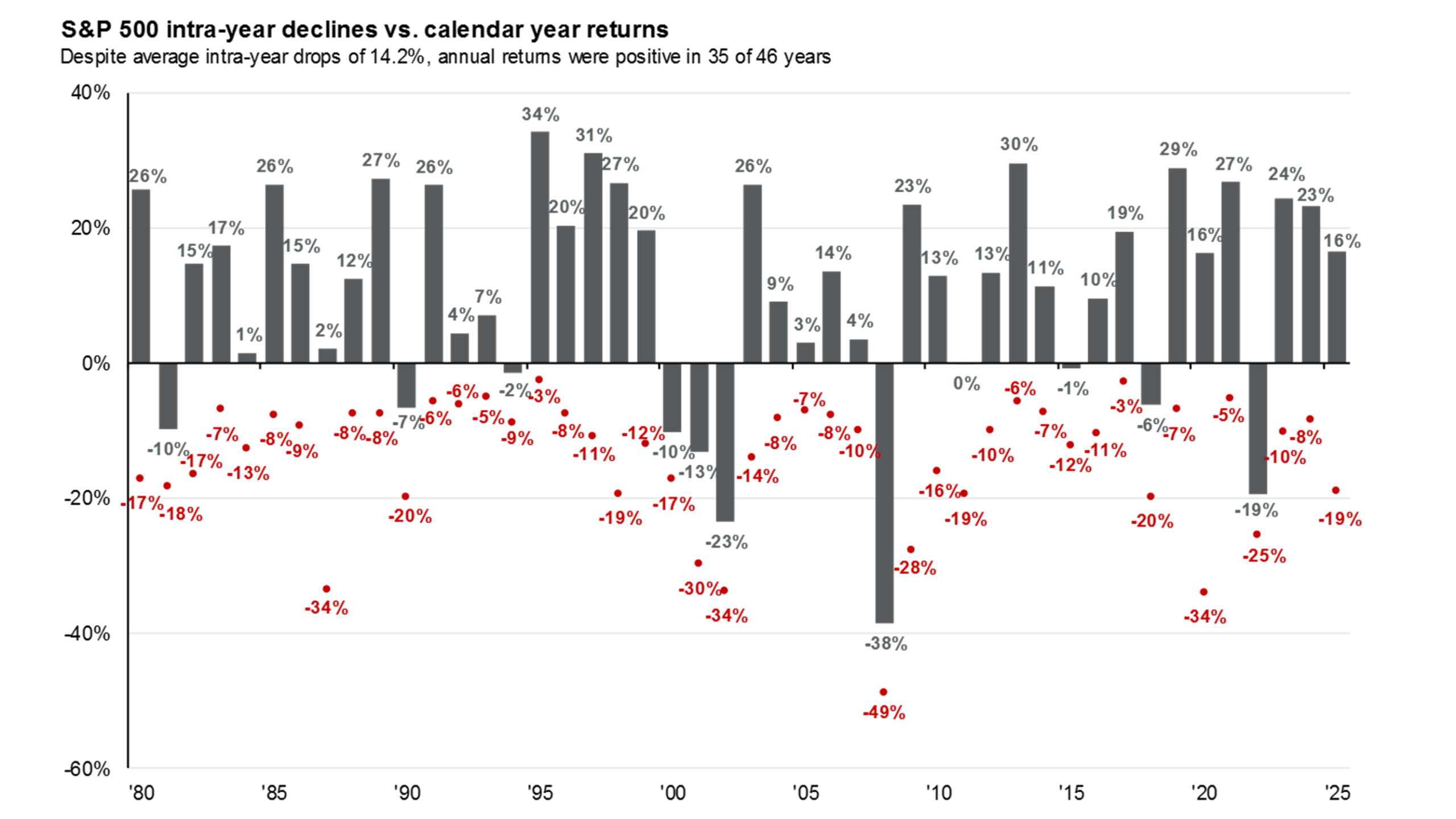
Daily market news and commentary can challenge your investment discipline. Some messages stir anxiety about the future, while others tempt you to chase the latest investment fad. When headlines unsettle you, consider the source and maintain a long‑term perspective.
6 – Focus on the things that are within your control
Certain things are within your control while others are not. You control your asset allocation, asset location, savings rates, spending habits, tax strategy, retirement planning, and estate planning. Don’t let these items deviate from your plan. You can’t control the return of the stock market, but you can control your exposure to it. We acknowledge the variables beyond our control and develop a risk management plan accordingly. This can lead to a better investment experience.